Sail area / displacement
How much sail the boat carries for its weight — its power in light air.
- 37.0· Racing
How it is worked out
sail area (ft²) ÷ (displacement as ft³ of seawater)^⅔
published upwind sail area
1 / 10
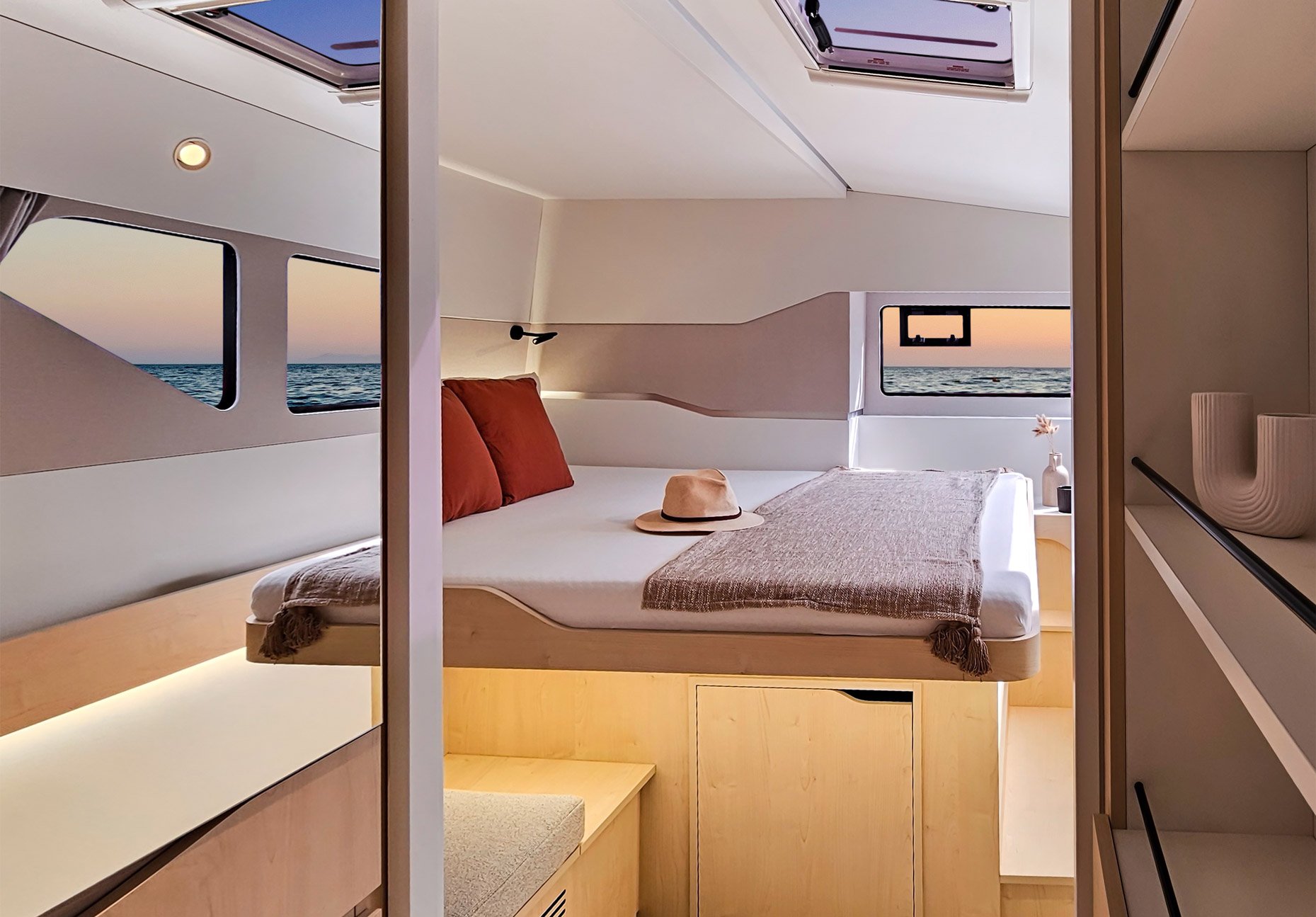
Windelo 54 interior master bedroom nordic zen — Windelo
* A standard reference image, not the actual boat — shown to help visualise this model's published dimensions.
From the published figures: CE Category A · LOA 16.24 m · fresh water 400 L
From the published figures: SA/D 37.0 (upwind 199 m², displacement 12800 kg) · 4 cabins
From the published figures: LOA 16.24 m · 4 cabins · fresh water 400 L
Tags are derived from certified class, length, sail area, accommodation and tankage using the criteria described on the Sources page; an editor may add or remove one.
Classic yacht-design ratios worked out from the builder's published figures, each shown against the bands designers read it by.
How much sail the boat carries for its weight — its power in light air.
sail area (ft²) ÷ (displacement as ft³ of seawater)^⅔
published upwind sail area
How heavy the boat is for its waterline length. Lower is lighter and quicker; higher is steadier and roomier.
displacement (long tons) ÷ (0.01 × waterline length in ft)³
Most builders publish a light displacement. The ratios were defined on a loaded boat, so every boat here reads a little lighter than a surveyor's figure would — all alike, which keeps them comparable.
What the builder publishes about how fast, how strong and how much the boat carries.
Fuel and water on one scale: a tank twice the height holds twice as much.
Certified CE design category A (Ocean): the wind and waves the EU Recreational Craft Directive says this boat is designed to take.
Sheltered waters
Inshore
Offshore
Ocean
Design limits set by the EU Recreational Craft Directive (2013/53/EU), in significant wave height. A category covers the conditions of those below it. It is the limit the boat was designed to, not a promise that it is safe in any conditions within it — that judgement stays with the skipper.
A figure marked with a quote mark was read from the builder's page. Open it for the exact line, the page and the date.
Figures read fromthe builder's page
Premium production
French builder of eco-friendly sailing catamarans, headquartered and built at its shipyard in Canet-en-Roussillon, Occitania.
Windelo was founded by Olivier Kauffmann, who ran Orangemarine and Cabesto and chaired Decathlon France, with Gautier Kauffmann, who came from Orangemarine's business and marketplace side and now runs operations. The boats are drawn by Christophe Barreau and Frédéric Neuman, naval architects with a long record in production performance catamarans -- the Catana 471, the Outremer 45, 49 and 51, the TS3 and TS5 -- and the problem they set themselves was the old antagonism of the type: sailing performance and the pleasure of steering against generous living space, resolved here by gathering helm and handling at the centre of the boat and putting the living space aft in the nacelle. The structure is an eco-composite sandwich developed with Patrick Ienny and Didier Perrin at the materials centre of IMT Mines Alès, using secondary raw materials that match virgin petroleum-based ones on the mechanical specification. After a year spent building it, the team moved into its own 1,600-square-metre factory in March 2020 at Canet-en-Roussillon in Occitanie, on a 4,000-square-metre quayside plot with room to grow to 10,800. Design office, component manufacture, assembly, fit-out, supply chain and sales are all inside the same building.
Visit brand pageEvery model Windelo publishes, by length — where this one sits in the range.
Boats this boat's designers also drew, for other builders too. Credits are grouped only where the names clearly agree, however each builder spelled them; an unclear one is left out.
Catana Catamarans
LOA: 15.75 m
HH Catamarans
LOA: 15.79 m
HH Catamarans
LOA: 16.74 m
Windelo
LOA: 15.24 m