Sail area / displacement
How much sail the boat carries for its weight — its power in light air.
- 26.2· Racing
How it is worked out
sail area (ft²) ÷ (displacement as ft³ of seawater)^⅔
published upwind sail area
1 / 10
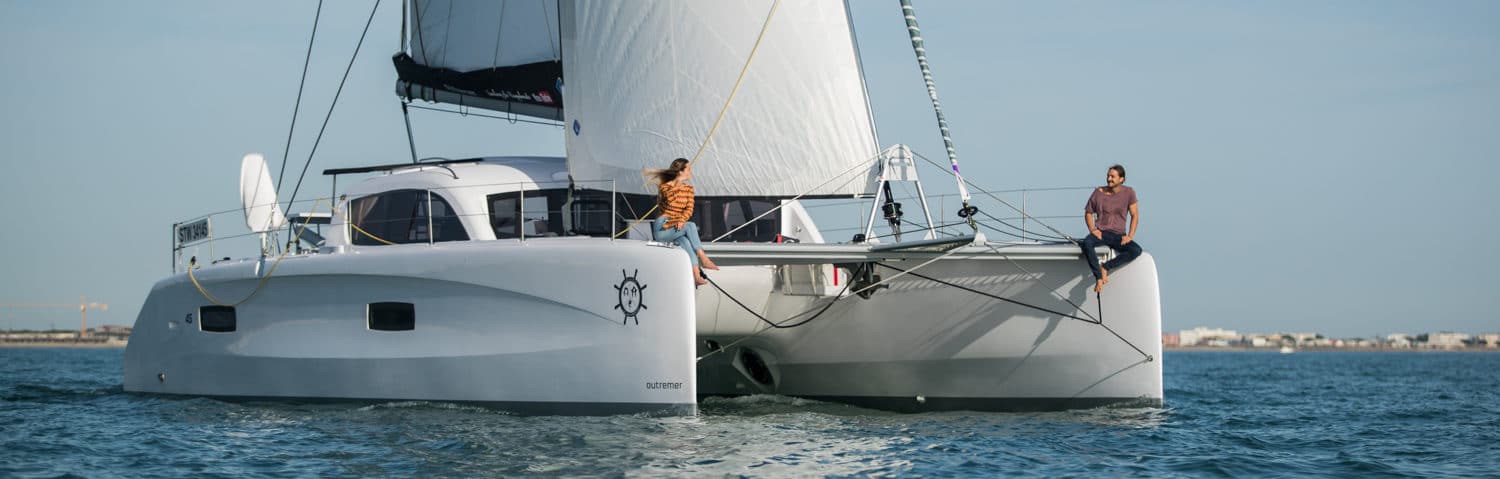
* A standard reference image, not the actual boat — shown to help visualise this model's published dimensions.
From the published figures: SA/D 26.2 (upwind 110 m², displacement 8800 kg) · 4 cabins
From the published figures: LOA 14.54 m · 4 cabins
Tags are derived from certified class, length, sail area, accommodation and tankage using the criteria described on the Sources page; an editor may add or remove one.
Classic yacht-design ratios worked out from the builder's published figures, each shown against the bands designers read it by.
How much sail the boat carries for its weight — its power in light air.
sail area (ft²) ÷ (displacement as ft³ of seawater)^⅔
published upwind sail area
How heavy the boat is for its waterline length. Lower is lighter and quicker; higher is steadier and roomier.
displacement (long tons) ÷ (0.01 × waterline length in ft)³
Most builders publish a light displacement. The ratios were defined on a loaded boat, so every boat here reads a little lighter than a surveyor's figure would — all alike, which keeps them comparable.
A figure marked with a quote mark was read from the builder's page. Open it for the exact line, the page and the date.
Figures read fromthe builder's page
Films of this model from the builder's official YouTube channel (Outremer Catamarans). They are the builder's own; the figures above are the reference.
An Outremer 45 and the wind.
Videos whose title names the Outremer 45, from the channel the builder's site links; last checked 9/30/2026. Playing one loads YouTube's player, which may set cookies.
Premium production
French builder of bluewater cruising catamarans, founded in 1984 in La Grande-Motte and now part of the Grand Large Yachting group.
In June 1984 at La Grande Motte, Gérard Danson, a young architect from the Conati yard, joined the yard's best technician, Daniel Cailloux, to build a powerful, seaworthy 40-foot catamaran for offshore cruising. Danson's conviction was that lightness, fine hulls and low windage are what make a bluewater multihull behave at sea. A second boat was under way before the first had launched, others joined, and the small firm needed a name: Outremer -- overseas. The early cruising multihulls were built to their owners' wishes, open cockpit or not, small coachroof or large, outboard or inboard, and they placed well in the races they entered. A 50-footer followed with more space, new sheds were built, the teams grew and a design office was set up; the first Outremer 45, Bagnoles de l'Orne, won the OSTAR under Didier Levillain, and families began to see the catamaran as a safe boat for a sabbatical year or a circumnavigation. Danson's death in 2005 closed the first era. In 2007 the Grand Large Yachting group restarted production and brought in leading multihull architects, and the Outremer 49 -- fully infused structure, balanced hulls, level spaces, all-round visibility -- renewed the bluewater catamaran. Close to 400 Outremers have sailed since 1984; the yard is present in fifteen countries and exports 70 per cent of what it builds.
Visit brand pageEvery model Outremer publishes, by length — where this one sits in the range.
Boats this boat's designers also drew, for other builders too. Credits are grouped only where the names clearly agree, however each builder spelled them; an unclear one is left out.
Outremer
LOA: 14.54 m
Outremer
LOA: 14.63 m
Outremer
LOA: 15.65 m
Nautitech
LOA: 12.6 m