Sail area / displacement
How much sail the boat carries for its weight — its power in light air.
- 16.5· Cruiser
How it is worked out
sail area (ft²) ÷ (displacement as ft³ of seawater)^⅔
published upwind sail area
1 / 10
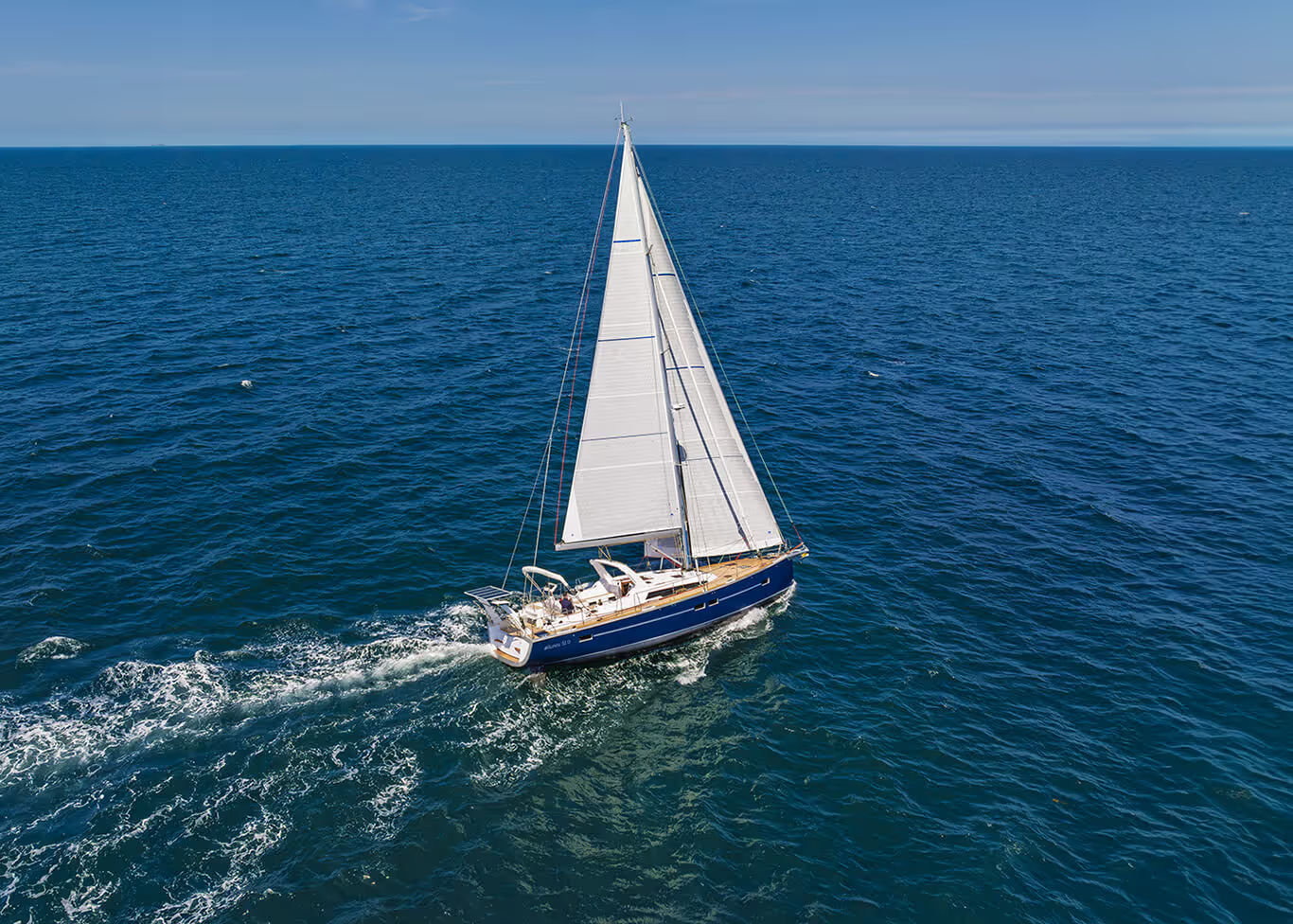
header-allures-519 — Allures Yachting
* A standard reference image, not the actual boat — shown to help visualise this model's published dimensions.
From the published figures: hull length 15.58 m · 3 cabins · fresh water 620 L
Tags are derived from certified class, length, sail area, accommodation and tankage using the criteria described on the Sources page; an editor may add or remove one.
Classic yacht-design ratios worked out from the builder's published figures, each shown against the bands designers read it by.
How much sail the boat carries for its weight — its power in light air.
sail area (ft²) ÷ (displacement as ft³ of seawater)^⅔
published upwind sail area
How heavy the boat is for its waterline length. Lower is lighter and quicker; higher is steadier and roomier.
displacement (long tons) ÷ (0.01 × waterline length in ft)³
The share of the weight carried in the keel — a rough guide to stiffness, though how deep that weight sits matters as much.
ballast ÷ displacement × 100
Ted Brewer's measure of how gently a boat moves in a seaway. Higher means a slower, easier motion.
displacement (lb) ÷ (0.65 × (0.7 × LWL + 0.3 × LOA) × beam^1.333), lengths in ft
A guide from the inquiry after the 1979 Fastnet race: below 2 was taken as suited to ocean passages. It ignores hull shape and where the ballast sits.
beam (ft) ÷ (displacement as ft³ of seawater)^⅓
Roughly the speed a displacement hull reaches before it has to climb its own bow wave.
1.34 × √(waterline length in ft), in knots
Most builders publish a light displacement. The ratios were defined on a loaded boat, so every boat here reads a little lighter than a surveyor's figure would — all alike, which keeps them comparable.
What the builder publishes about how fast, how strong and how much the boat carries.
Fuel and water on one scale: a tank twice the height holds twice as much.
27 gal of water per berth
Figures read fromallures.com/en/comparez-nos-modelesread 9/13/2026from the site's comparison table
1 drawing from the builder's page: general arrangement, sail plan, profile.
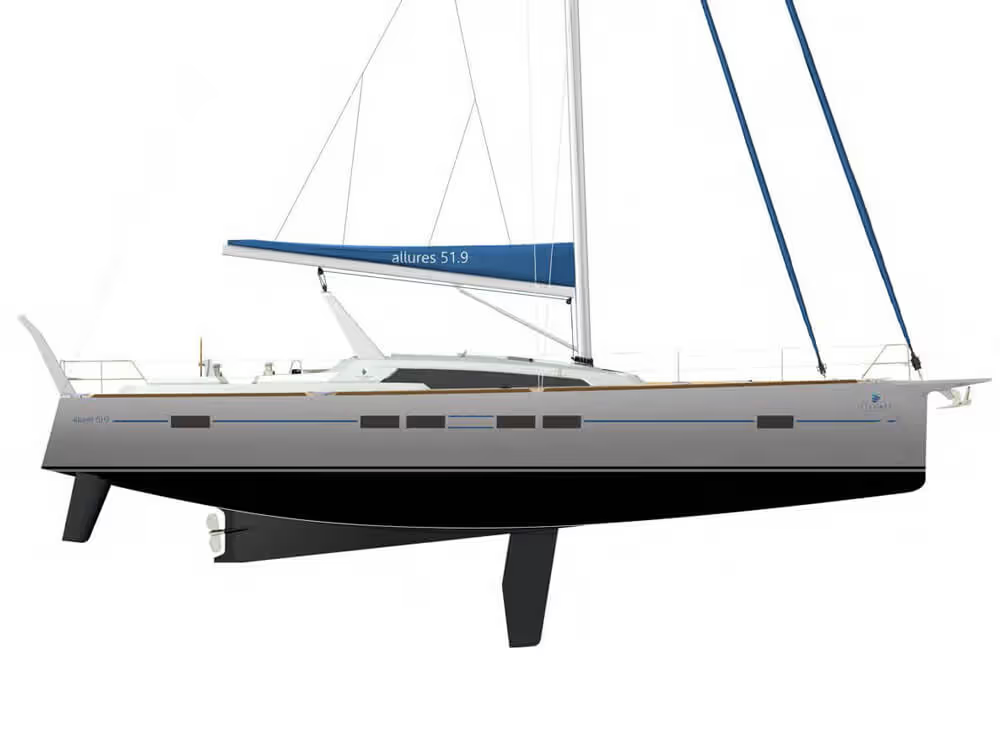
Allures-51-9-centerboard-down-profile — Allures Yachting
Semi-custom
French builder of aluminium blue-water cruising sailboats, founded in 2003 and part of the Grand Large Yachting group.
Allures Yachting was founded in 2003 as a French builder of aluminium sailboats for long-distance voyaging, from 40 to 52 feet. Its first generation of models started the story; by 2010 the yard was producing fifteen boats a year, had gained the industrial capacity to build its own hulls, and moved into a new building in Cherbourg where carpentry, equipment, deck and rigging were brought under one roof. The range was renewed in that period -- the 45 replaced the 44, the 52 succeeded the 51 in 2016, and the 40 evolved into the 39.9 -- and in 2017 a third generation began with the 40.9, 45.9 and 51.9, completed in 2021 with the 51.9, the first Allures with an aft cabin and a long cockpit. In 2019 an Allures 44 completed the Northwest Passage while an Allures 45 sailed Patagonia, and in 2025 the Horizon 47 revisited the bluewater cruising sailboat.
Visit brand pageEvery model Allures Yachting publishes, by length — where this one sits in the range.
Boats this boat's designers also drew, for other builders too. Credits are grouped only where the names clearly agree, however each builder spelled them; an unclear one is left out.