Sail area / displacement
How much sail the boat carries for its weight — its power in light air.
- not published: sail area, displacement
How it is worked out
sail area (ft²) ÷ (displacement as ft³ of seawater)^⅔
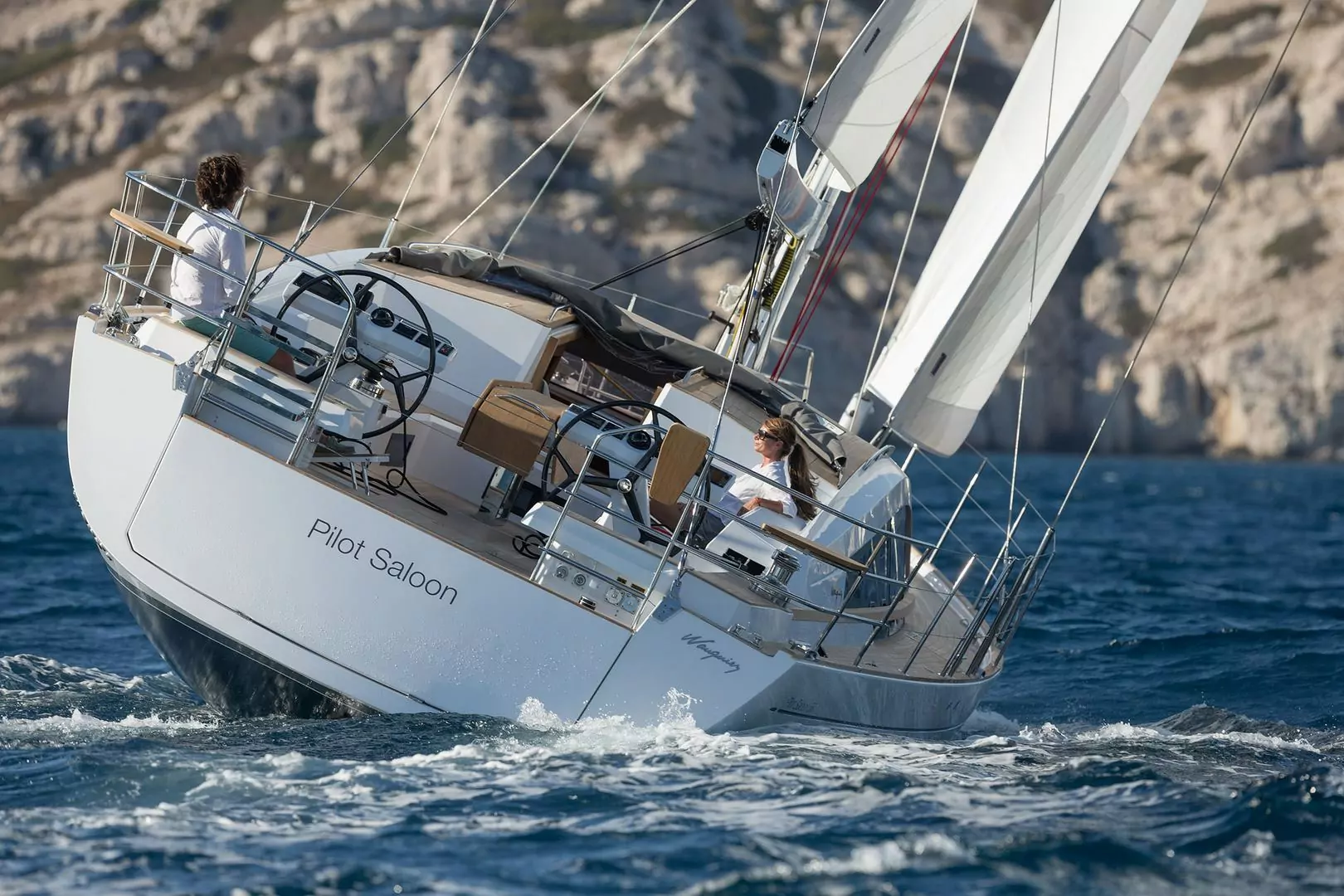
1 / 10
Pilot Saloon 58 exterior — Wauquiez
* A standard reference image, not the actual boat — shown to help visualise this model's published dimensions.
From the published figures: LOA 17.7 m · 4 cabins
Tags are derived from certified class, length, sail area, accommodation and tankage using the criteria described on the Sources page; an editor may add or remove one.
Classic yacht-design ratios worked out from the builder's published figures, each shown against the bands designers read it by.
How much sail the boat carries for its weight — its power in light air.
sail area (ft²) ÷ (displacement as ft³ of seawater)^⅔
How heavy the boat is for its waterline length. Lower is lighter and quicker; higher is steadier and roomier.
displacement (long tons) ÷ (0.01 × waterline length in ft)³
The share of the weight carried in the keel — a rough guide to stiffness, though how deep that weight sits matters as much.
ballast ÷ displacement × 100
Ted Brewer's measure of how gently a boat moves in a seaway. Higher means a slower, easier motion.
displacement (lb) ÷ (0.65 × (0.7 × LWL + 0.3 × LOA) × beam^1.333), lengths in ft
A guide from the inquiry after the 1979 Fastnet race: below 2 was taken as suited to ocean passages. It ignores hull shape and where the ballast sits.
beam (ft) ÷ (displacement as ft³ of seawater)^⅓
Roughly the speed a displacement hull reaches before it has to climb its own bow wave.
1.34 × √(waterline length in ft), in knots
Most builders publish a light displacement. The ratios were defined on a loaded boat, so every boat here reads a little lighter than a surveyor's figure would — all alike, which keeps them comparable.
A figure marked with a quote mark was read from the builder's page. Open it for the exact line, the page and the date.
Figures read fromthe builder's page
Semi-custom
French builder of offshore-cruising sailing monohulls, founded in 1965 by Henri Wauquiez and based in Neuville-en-Ferrain, France.
Henri Wauquiez gave the yard his name in 1965 and spent his life building uncommon boats; the yard says it never took the industrial road, preferring to let the craft speak. The model list reads as its history. It opened with Holman & Pye designs -- the Elizabethan 29 of 1965, the Elizabethan 35 and Victorian of 1966, the Centurion 32 of 1968 -- then the Chance 37 in 1973, the Amphitrite in 1975, the Gladiateur in 1977, the Hood 38 in 1978 and the Pretorien in 1979, with the first boats of the yard's own drawing, the Antigua 34 and 37, in 1980 and 1981. Ed Dubois then shaped the line for two decades, from the Centurion 47 of 1984 through the 42, 38, 36 and 40 to the Centurion 59, 45 and 49 of 1990, the Centurion 61S and the Pilot Saloon 60 of 1991, and the Pilot Saloon 54, 48 and 43 that followed. Berret-Racoupeau took over from the Pilot Saloon 40 of 2000, drawing the 41, 47 and 55, the Centurion 40S.2, the Optio and the Centurion 57; Marc Lombard drew the Opium 39 of 2010 and, with Roseo, the Wauquiez 55 of 2024. These are offshore boats meant to be sailed: hulls infused for the resin-to-fibre ratio and the weight, decks and hulls in balsa sandwich for stiffness and for thermal and acoustic insulation.
Visit brand pageEvery model Wauquiez publishes, by length — where this one sits in the range.
Boats this boat's designers also drew, for other builders too. Credits are grouped only where the names clearly agree, however each builder spelled them; an unclear one is left out.
Contest Yachts
LOA: 18.1 m
Kraken Yachts
LOA: 17.67 m