Sail area / displacement
How much sail the boat carries for its weight — its power in light air.
- 17.8· Cruiser
How it is worked out
sail area (ft²) ÷ (displacement as ft³ of seawater)^⅔
mainsail + genoa, added up
1 / 9
Chantiers Amel
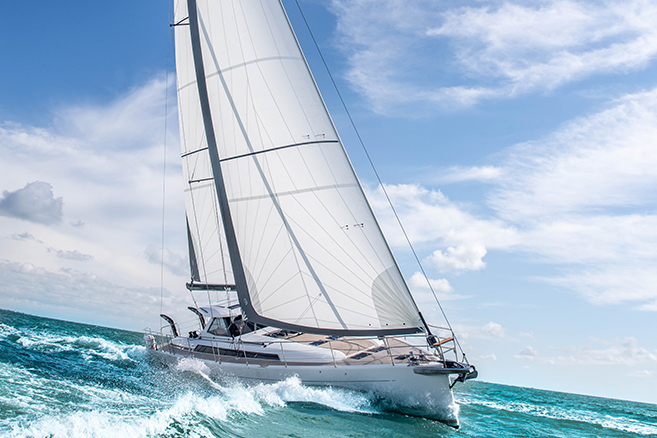
* A standard reference image, not the actual boat — shown to help visualise this model's published dimensions.
From the published figures: LOA 19 m · 3 cabins · 3 heads · fresh water 700 L
Tags are derived from certified class, length, sail area, accommodation and tankage using the criteria described on the Sources page; an editor may add or remove one.
Classic yacht-design ratios worked out from the builder's published figures, each shown against the bands designers read it by.
How much sail the boat carries for its weight — its power in light air.
sail area (ft²) ÷ (displacement as ft³ of seawater)^⅔
mainsail + genoa, added up
How heavy the boat is for its waterline length. Lower is lighter and quicker; higher is steadier and roomier.
displacement (long tons) ÷ (0.01 × waterline length in ft)³
The share of the weight carried in the keel — a rough guide to stiffness, though how deep that weight sits matters as much.
ballast ÷ displacement × 100
Ted Brewer's measure of how gently a boat moves in a seaway. Higher means a slower, easier motion.
displacement (lb) ÷ (0.65 × (0.7 × LWL + 0.3 × LOA) × beam^1.333), lengths in ft
A guide from the inquiry after the 1979 Fastnet race: below 2 was taken as suited to ocean passages. It ignores hull shape and where the ballast sits.
beam (ft) ÷ (displacement as ft³ of seawater)^⅓
Roughly the speed a displacement hull reaches before it has to climb its own bow wave.
1.34 × √(waterline length in ft), in knots
Most builders publish a light displacement. The ratios were defined on a loaded boat, so every boat here reads a little lighter than a surveyor's figure would — all alike, which keeps them comparable.
What the builder publishes about how fast, how strong and how much the boat carries.
Fuel and water on one scale: a tank twice the height holds twice as much.
A figure marked with a quote mark was read from the builder's page. Open it for the exact line, the page and the date.
Figures read fromthe builder's page
Films of this model from the builder's official YouTube channel (Amel Yachts). They are the builder's own; the figures above are the reference.
AMEL 60 - Journée en mer et visite guidée / A day at sea and a guided tour
Amel Yachts · 4/30/2026
Visite Amel 60 – Cannes Yachting Festival
Amel Yachts · 1/4/2023
Videos whose title names the Amel 60, from the channel the builder's site links; last checked 9/30/2026. Playing one loads YouTube's player, which may set cookies.
Premium production
French builder of blue-water cruising monohulls, based in Périgny (La Rochelle) since the shipyard's founding in 1964.
Henri Amel, born Henri Tonet in 1913, sailed from his youth, began building boats in his Paris coachwork company and continued in Lyon after the war, and though wounded in one eye and later blind for many years never gave up his dream of robust, comfortable, easy-to-handle sailing boats. The Amel yard began in La Rochelle in 1964 when he took over ARPIN in the Ville-en-Bois district; after fire destroyed the workshops on 3 February 1968 he built a new yard at Périgny, inaugurated in January 1969, where every Amel has been built since. In 1973 he was one of the four La Rochelle builders who created the Grand Pavois boat show, the company became Chantiers Amel S.A. in 1978, the Maramu, Sharki and Mango followed, the first Amel furling systems appeared in 1983 and the retractable bow thruster in 1985, and the Super Maramu of 1988 led to the Super Maramu 2000, Cruising World's Boat of the Year in 2000. Henri Amel died on 12 April 2005, and from then every yacht has carried the name Amel -- the 54, the 64 and 55, the Amel 50 of 2017, European Yacht of the Year 2018, and the Amel 60 of 2019.
Visit brand pageEvery model Amel publishes, by length — where this one sits in the range.
Boats this boat's designers also drew, for other builders too. Credits are grouped only where the names clearly agree, however each builder spelled them; an unclear one is left out.