Sail area / displacement
How much sail the boat carries for its weight — its power in light air.
- 22.8· Performance
How it is worked out
sail area (ft²) ÷ (displacement as ft³ of seawater)^⅔
mainsail + jib, added up
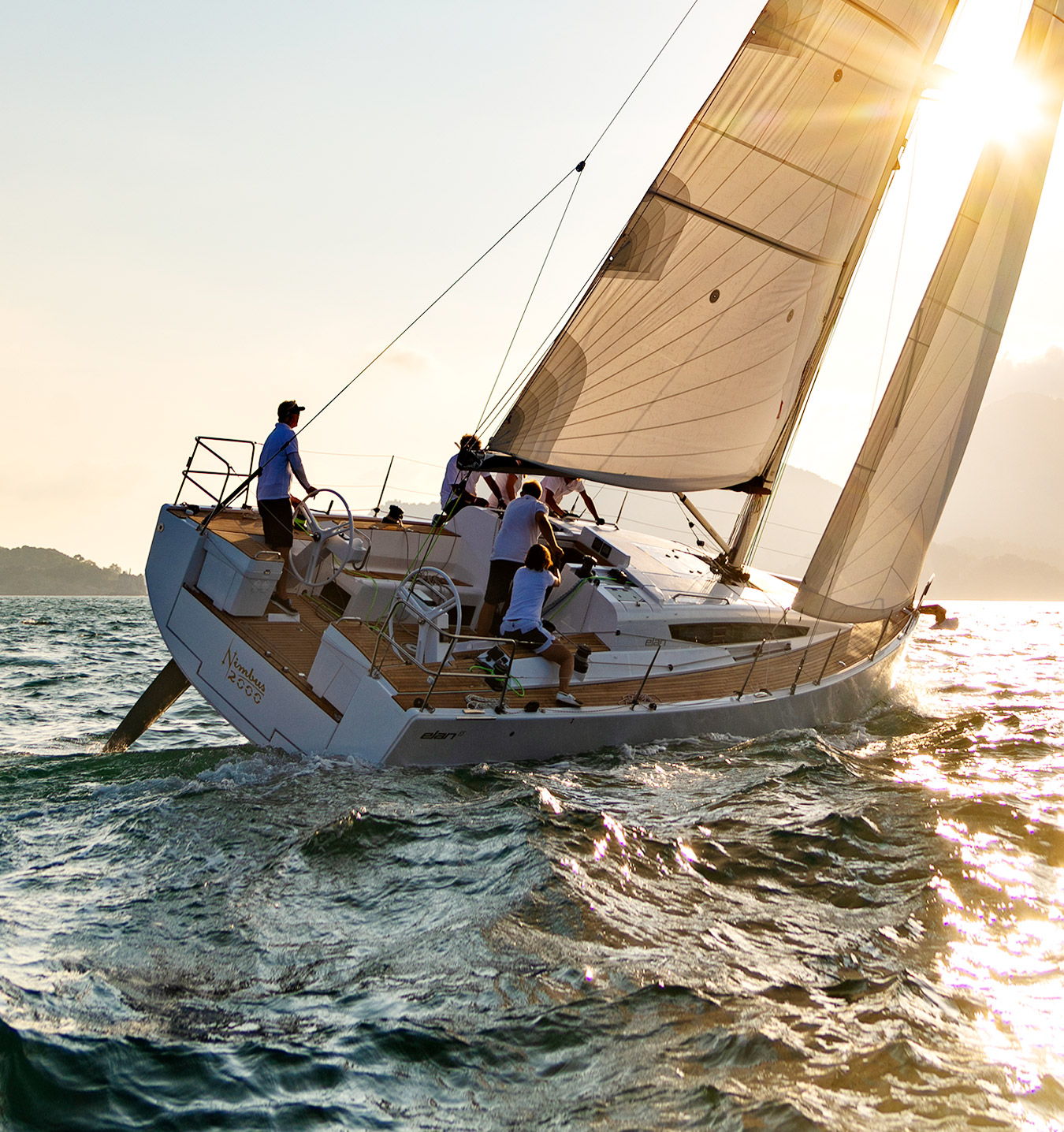
1 / 11
* A standard reference image, not the actual boat — shown to help visualise this model's published dimensions.
From the published figures: CE Category A · LOA 11.96 m · fresh water 277 L
From the published figures: performance cruiser · 3 cabins
From the published figures: LOA 11.96 m · mainsail 52.16 m²
Tags are derived from certified class, length, sail area, accommodation and tankage using the criteria described on the Sources page; an editor may add or remove one.
Classic yacht-design ratios worked out from the builder's published figures, each shown against the bands designers read it by.
How much sail the boat carries for its weight — its power in light air.
sail area (ft²) ÷ (displacement as ft³ of seawater)^⅔
mainsail + jib, added up
How heavy the boat is for its waterline length. Lower is lighter and quicker; higher is steadier and roomier.
displacement (long tons) ÷ (0.01 × waterline length in ft)³
The share of the weight carried in the keel — a rough guide to stiffness, though how deep that weight sits matters as much.
ballast ÷ displacement × 100
Ted Brewer's measure of how gently a boat moves in a seaway. Higher means a slower, easier motion.
displacement (lb) ÷ (0.65 × (0.7 × LWL + 0.3 × LOA) × beam^1.333), lengths in ft
A guide from the inquiry after the 1979 Fastnet race: below 2 was taken as suited to ocean passages. It ignores hull shape and where the ballast sits.
beam (ft) ÷ (displacement as ft³ of seawater)^⅓
Roughly the speed a displacement hull reaches before it has to climb its own bow wave.
1.34 × √(waterline length in ft), in knots
Most builders publish a light displacement. The ratios were defined on a loaded boat, so every boat here reads a little lighter than a surveyor's figure would — all alike, which keeps them comparable.
What the builder publishes about how fast, how strong and how much the boat carries.
Fuel and water on one scale: a tank twice the height holds twice as much.
Certified CE design category A (Ocean): the wind and waves the EU Recreational Craft Directive says this boat is designed to take.
Sheltered waters
Inshore
Offshore
Ocean
Design limits set by the EU Recreational Craft Directive (2013/53/EU), in significant wave height. A category covers the conditions of those below it. It is the limit the boat was designed to, not a promise that it is safe in any conditions within it — that judgement stays with the skipper.
A figure marked with a quote mark was read from the builder's page. Open it for the exact line, the page and the date.
Figures read fromthe builder's page
Films of this model from the builder's official YouTube channel (ElanYachts). They are the builder's own; the figures above are the reference.
Meet the Owner: Preparing to race the AEGEAN 600 with Elan E5
ElanYachts · 11/26/2024
Videos whose title names the E5, from the channel the builder's site links; last checked 9/30/2026. Playing one loads YouTube's player, which may set cookies.
Premium production
Slovenian builder of cruising and racing sailing yachts, based in Begunje na Gorenjskem, offering the E, Impression, and GT lines.
Elan was founded in 1945 by Rudi Finžgar -- ski jumper, carpenter and innovator -- as a workshop for skis and sporting goods, in the Alpine woodworking country above Lake Bled. Boatbuilding followed in 1949 with wooden boats for the local lakes, and in 1962 Elan became one of the first European yards to adopt glass-reinforced polyester, producing rowing, sailing and outboard boats in their thousands for Italy, Scandinavia and Germany; the GT 495 was the bestseller. From 1978 the yard worked in advanced composites -- vacuum epoxy and post-curing, later carbon epoxy -- building hundreds of high-performance sailplanes with the German specialist Glaser-Dirks. The partnership with J&J Design, founded by Japec and Jernej Jakopin, began in 1983 and produced the cruiser-racers Elan 31, 33, 39, 43 and 35 Performance; the 31R won the 1985 IOR Three-Quarter Ton Worlds and yacht revenues grew tenfold by 1987. A new performance line designed by Rob Humphreys arrived in 1992, opening a partnership of decades that brought three European Yacht of the Year awards. Elan moved to vacuum-assisted infusion in the early 2000s -- the first European yard to use it in series production -- completing the shift from open-mould lamination in 2003, and by 2006-2007 was building over 300 boats a year. The Elan 350 took European Yacht of the Year in 2011 by unanimous vote, and the GT6 of 2020, the E6 of 2021 and the bluewater GT6 Explorer of 2023 mark the yard's move towards performance luxury.
Visit brand pageEvery model Elan publishes, by length — where this one sits in the range.
Boats this boat's designers also drew, for other builders too. Credits are grouped only where the names clearly agree, however each builder spelled them; an unclear one is left out.
Arcona Yachts
LOA: 12.2 m
Arcona Yachts
LOA: 11.3 m