Sail area / displacement
How much sail the boat carries for its weight — its power in light air.
- 28.0· Racing
How it is worked out
sail area (ft²) ÷ (displacement as ft³ of seawater)^⅔
published upwind sail area
1 / 10
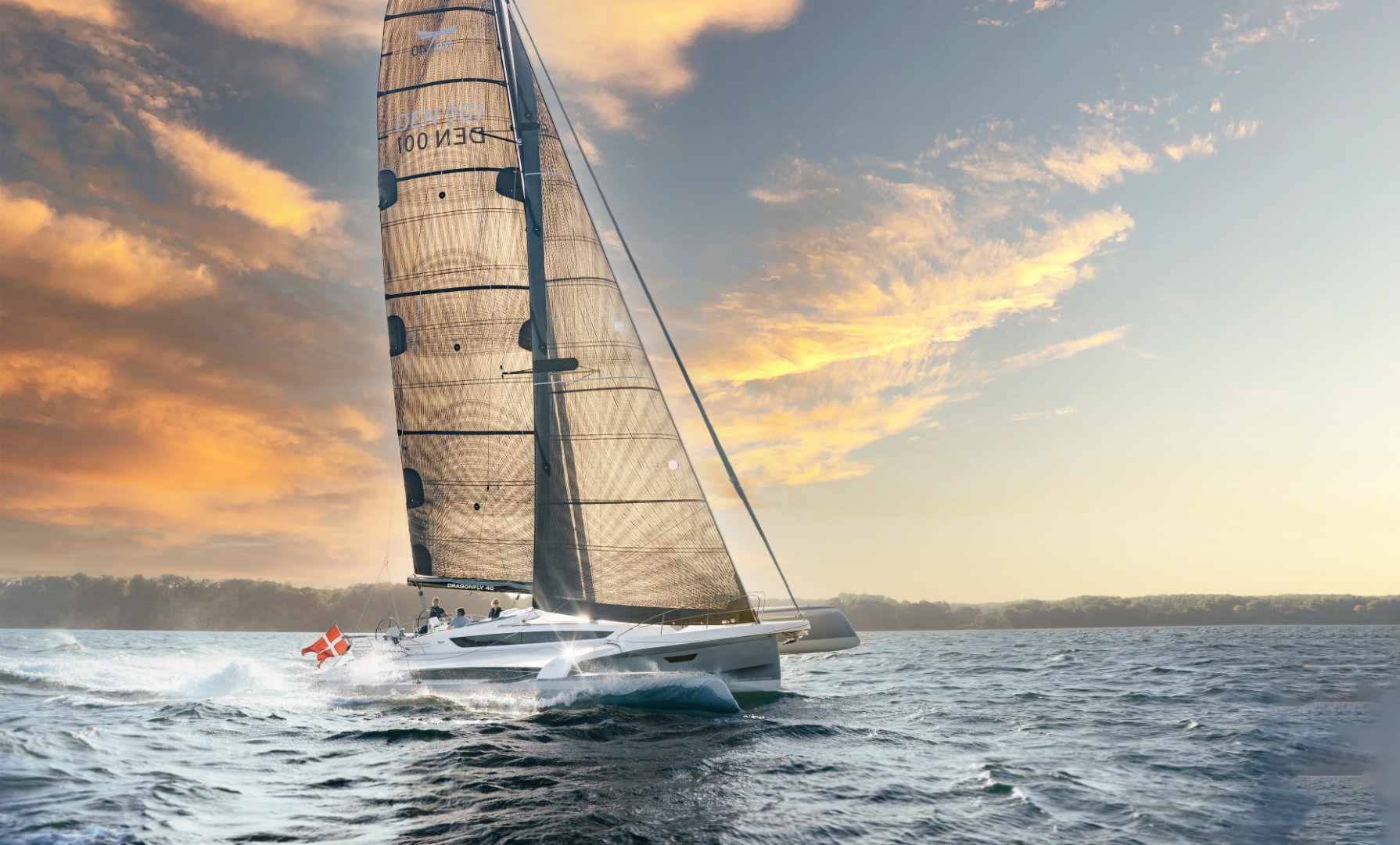
Side-4-5_Dobbelt-side_NEWSKY-ExtraWideBright-Large — Quorning Boats
* A standard reference image, not the actual boat — shown to help visualise this model's published dimensions.
From the published figures: CE Category A · LOA 12.4 m · fresh water 220 L
From the published figures: SA/D 28.0 (upwind 90 m², displacement 5900 kg) · 2 cabins
From the published figures: LOA 12.4 m · upwind 90 m²
Tags are derived from certified class, length, sail area, accommodation and tankage using the criteria described on the Sources page; an editor may add or remove one.
Classic yacht-design ratios worked out from the builder's published figures, each shown against the bands designers read it by.
How much sail the boat carries for its weight — its power in light air.
sail area (ft²) ÷ (displacement as ft³ of seawater)^⅔
published upwind sail area
How heavy the boat is for its waterline length. Lower is lighter and quicker; higher is steadier and roomier.
displacement (long tons) ÷ (0.01 × waterline length in ft)³
Most builders publish a light displacement. The ratios were defined on a loaded boat, so every boat here reads a little lighter than a surveyor's figure would — all alike, which keeps them comparable.
What the builder publishes about how fast, how strong and how much the boat carries.
Fuel and water on one scale: a tank twice the height holds twice as much.
Certified CE design category A (Ocean): the wind and waves the EU Recreational Craft Directive says this boat is designed to take.
Sheltered waters
Inshore
Offshore
Ocean
Design limits set by the EU Recreational Craft Directive (2013/53/EU), in significant wave height. A category covers the conditions of those below it. It is the limit the boat was designed to, not a promise that it is safe in any conditions within it — that judgement stays with the skipper.
Figures read fromdragonfly.dk/dragonfly-40-specifications/read 9/14/2026
Semi-custom
Danish family yard building folding Swing Wing cruising trimarans since 1967 — today the Dragonfly 25, 28, 33, 36 and 40, from 7.65 to 12.40 metres — founded by Børge Quorning at Skærbæk near Fredericia and run by his son Jens, with some 40 boats a year.
Børge Quorning came home to Denmark in 1966 from boatbuilding in Canada with one ambition, to build trimarans and make Europeans appreciate them, and in August 1967 he and his brother Bent built a yard at Skærbæk with their own hands -- the same hall still stands beside the office. The first boat, the Trident 28 of 1968, found only one buyer, so the brothers kept the yard alive with the double-ended Luna 19 and Luna 26 while experimenting with trimaran prototypes; the 16-foot plywood boat Børge built for his sons in 1972 was the first to carry the name Dragonfly. The brothers parted in 1974, the Trident 27 became the first production trimaran and the Dragonfly 25 followed in 1980, but the milestone came in August 1989 with the Dragonfly 800 Swing Wing, the first folding Dragonfly. Jens Quorning took over from his parents in 1995; the Dragonfly 920 of 1996 sold 168 boats, the 1200 flagship arrived in 2000, and 3D design from 2005 produced the Dragonfly 35, then the 28, 32 and 25. The Dragonfly 40 premiered at boot Düsseldorf in 2020 and was European Yacht of the Year 2021, the yard's fourth; trimaran number 1,000 was built in early 2022, shortly before Børge Quorning died at ninety, and the Dragonfly 36 followed in 2024 -- with Peter Quorning, the third generation, now Vice President.
Visit brand pageEvery model Dragonfly Trimarans publishes, by length — where this one sits in the range.
Dragonfly Trimarans
LOA: 11.55 m
Rapido Trimarans
LOA: 12.03 m
NEEL Trimarans
LOA: 12.9 m