Sail area / displacement
How much sail the boat carries for its weight — its power in light air.
- not published: sail area
How it is worked out
sail area (ft²) ÷ (displacement as ft³ of seawater)^⅔
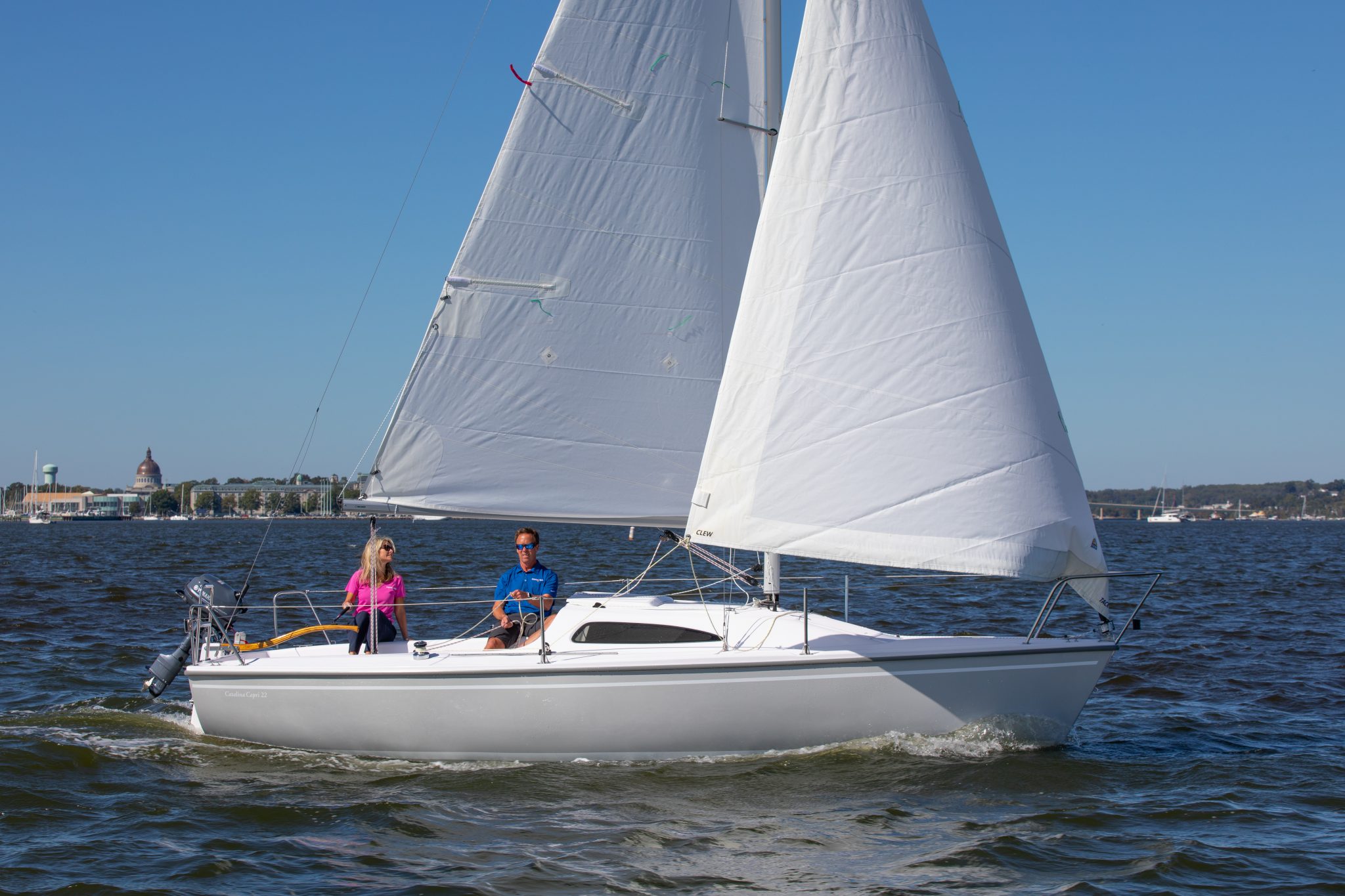
1 / 10
20211019_catalina22_1501-2048x1365 — Catalina Yachts
* A standard reference image, not the actual boat — shown to help visualise this model's published dimensions.
Classic yacht-design ratios worked out from the builder's published figures, each shown against the bands designers read it by.
How much sail the boat carries for its weight — its power in light air.
sail area (ft²) ÷ (displacement as ft³ of seawater)^⅔
How heavy the boat is for its waterline length. Lower is lighter and quicker; higher is steadier and roomier.
displacement (long tons) ÷ (0.01 × waterline length in ft)³
The share of the weight carried in the keel — a rough guide to stiffness, though how deep that weight sits matters as much.
ballast ÷ displacement × 100
Ted Brewer's measure of how gently a boat moves in a seaway. Higher means a slower, easier motion.
displacement (lb) ÷ (0.65 × (0.7 × LWL + 0.3 × LOA) × beam^1.333), lengths in ft
A guide from the inquiry after the 1979 Fastnet race: below 2 was taken as suited to ocean passages. It ignores hull shape and where the ballast sits.
beam (ft) ÷ (displacement as ft³ of seawater)^⅓
Roughly the speed a displacement hull reaches before it has to climb its own bow wave.
1.34 × √(waterline length in ft), in knots
Most builders publish a light displacement. The ratios were defined on a loaded boat, so every boat here reads a little lighter than a surveyor's figure would — all alike, which keeps them comparable.
Figures read fromcatalinayachts.com/sport-series/22-capri/· SPECSread 10/18/2026
Volume production
American sailboat builder founded by Frank Butler in 1970, which calls itself America's largest sailboat builder — the 22 Sport and 22 Capri trailerables, the 276 Sport, the 6 Series 316, 356, 386 and 426 and the 445, from 7.3 to 13.5 metres, owned, designed and built in Largo, Florida.
Catalina's first model, the Catalina 22, was built in North Hollywood, California, in July 1969, when owner Frank Butler hoped to build a hundred boats; he founded Catalina Yachts in 1970 with the goal, the company says, of building good boats that are a good value. The Catalina 27 followed in March 1970 and the Catalina 30 in December 1974, and the 22 passed hull number 5,000 in 1975 and 10,000 in 1980, by then built at Catalina's East and West Coast plants and in England, Australia and Canada. In 1984 Catalina acquired Morgan Yachts in Largo, Florida, which became its Morgan Division, building cruising and charter boats and many Catalina models on the East Coast. The first Catalina 42 of 1989 delivered 100 hulls in its first year, and in 1990 the Catalina 30 reached hull 6,000 and the 22 hull 15,000. The 1990s brought the 270, 320, 400, 380 and 470, and in 1995 Frank Butler received SAIL's Industry Award for Leadership. In December 1998 he took Sharon Day, vice-president of sales, and Gerry Douglas, vice-president of engineering, as partners in his privately held company. The company says Sharon Day, who worked alongside Frank for 48 years, now leads a veteran team that carries his vision forward at what it calls America's largest sailboat builder.
Visit brand pageEvery model Catalina Yachts publishes, by length — where this one sits in the range.
Catalina Yachts
LOA: 7.26 m
Saffier Yachts
LOA: 7 m