Sail area / displacement
How much sail the boat carries for its weight — its power in light air.
- not published: sail area
How it is worked out
sail area (ft²) ÷ (displacement as ft³ of seawater)^⅔
1 / 10
4322D901-B26F-4786-AC91-B747F982B119 — Advanced Yachts
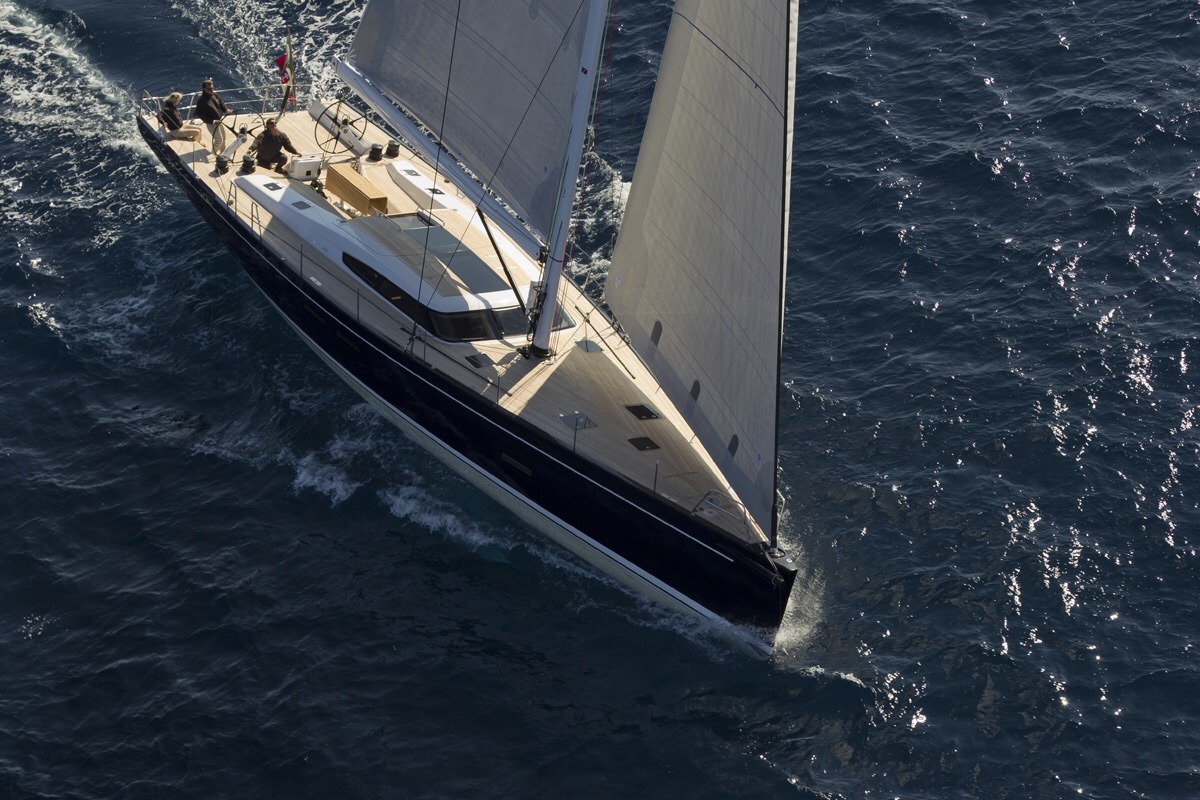
* A standard reference image, not the actual boat — shown to help visualise this model's published dimensions.
Classic yacht-design ratios worked out from the builder's published figures, each shown against the bands designers read it by.
How much sail the boat carries for its weight — its power in light air.
sail area (ft²) ÷ (displacement as ft³ of seawater)^⅔
How heavy the boat is for its waterline length. Lower is lighter and quicker; higher is steadier and roomier.
displacement (long tons) ÷ (0.01 × waterline length in ft)³
The share of the weight carried in the keel — a rough guide to stiffness, though how deep that weight sits matters as much.
ballast ÷ displacement × 100
Ted Brewer's measure of how gently a boat moves in a seaway. Higher means a slower, easier motion.
displacement (lb) ÷ (0.65 × (0.7 × LWL + 0.3 × LOA) × beam^1.333), lengths in ft
A guide from the inquiry after the 1979 Fastnet race: below 2 was taken as suited to ocean passages. It ignores hull shape and where the ballast sits.
beam (ft) ÷ (displacement as ft³ of seawater)^⅓
Roughly the speed a displacement hull reaches before it has to climb its own bow wave.
1.34 × √(waterline length in ft), in knots
Most builders publish a light displacement. The ratios were defined on a loaded boat, so every boat here reads a little lighter than a surveyor's figure would — all alike, which keeps them comparable.
What the builder publishes about how fast, how strong and how much the boat carries.
Fuel and water on one scale: a tank twice the height holds twice as much.
Figures read fromadvancedyachts.com/yachts/a66-2/a66/· Technical Specificationsread 10/17/2026
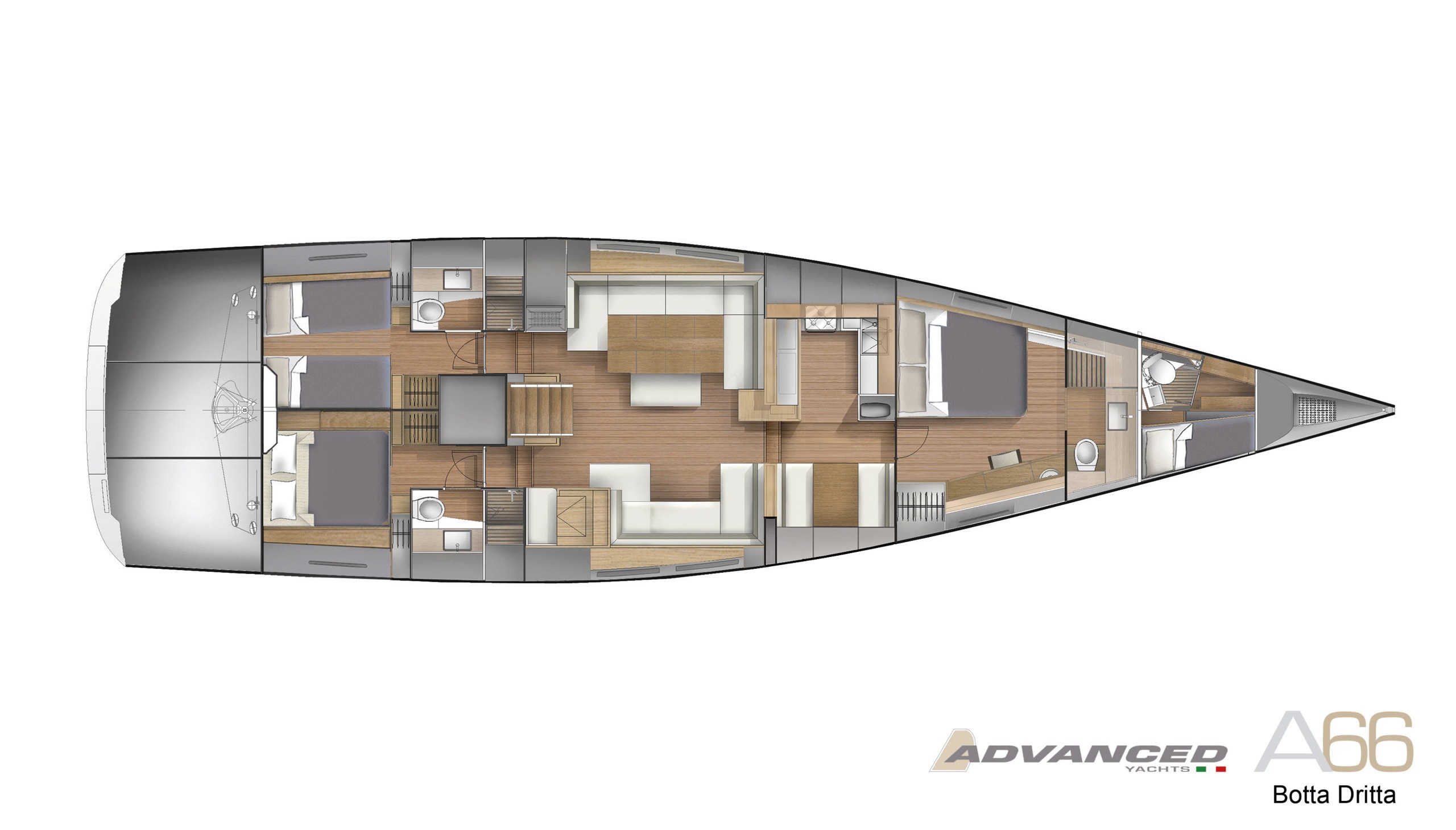
1 drawing from the builder's page: general arrangement, sail plan, profile.
A66-Botta-Dritta-scaled-1 — Advanced Yachts
Semi-custom
Milan-based Italian sailing-yacht atelier building a few semi-custom performance cruisers a year — the 18.6-metre A62, the 20.5-metre A66 and the 24-metre A80, the latter two drawn by Reichel/Pugh with design by Nauta Design, and the 22-metre AC72 catamaran whose first hull is in build.
Advanced Yachts presents itself as a company of sailors who have been sailing for more than forty years and as a true sailing-yacht atelier: limited production, each yacht made to measure for its future owner, every one built in Italy by artisans and small specialist firms, from shipbuilding and carpentry to teak decks, lighting, engineering and fabrics. Its boat pages tell the story of the range. The first A66, One Shot, was built for an experienced owner who spends long periods aboard and has since sailed the Mediterranean and the Atlantic; the second, Botta Dritta, for a racing owner who wanted both long Mediterranean cruises and competitive regattas. The first A80, Apsaras, was built for a Hong Kong owner who had fallen for the A66 but wanted a larger boat; presented at the Monaco Yacht Show, she won the cruising category of the ARC, spent a season in the Caribbean and set off round the world by way of South Africa, Madagascar, the Philippines and Australia, racing the Sydney–Hobart on the way. Jikan, the second A80, was built for an English owner with a furling boom and self-tacking jib for short-handed sailing, and Mindfulness, the third, combines the two with a shoal-draft keel and is offered for charter. Salt, developed after the first A80s, became the first A66s. In 2025 the yard announced the AC72 catamaran, its first boat entering construction, and moved to the advancedyachts.com address.
Visit brand pageEvery model Advanced Yachts publishes, by length — where this one sits in the range.
Boats this boat's designers also drew, for other builders too. Credits are grouped only where the names clearly agree, however each builder spelled them; an unclear one is left out.