Sail area / displacement
How much sail the boat carries for its weight — its power in light air.
- 23.5· Performance
How it is worked out
sail area (ft²) ÷ (displacement as ft³ of seawater)^⅔
published upwind sail area
1 / 10
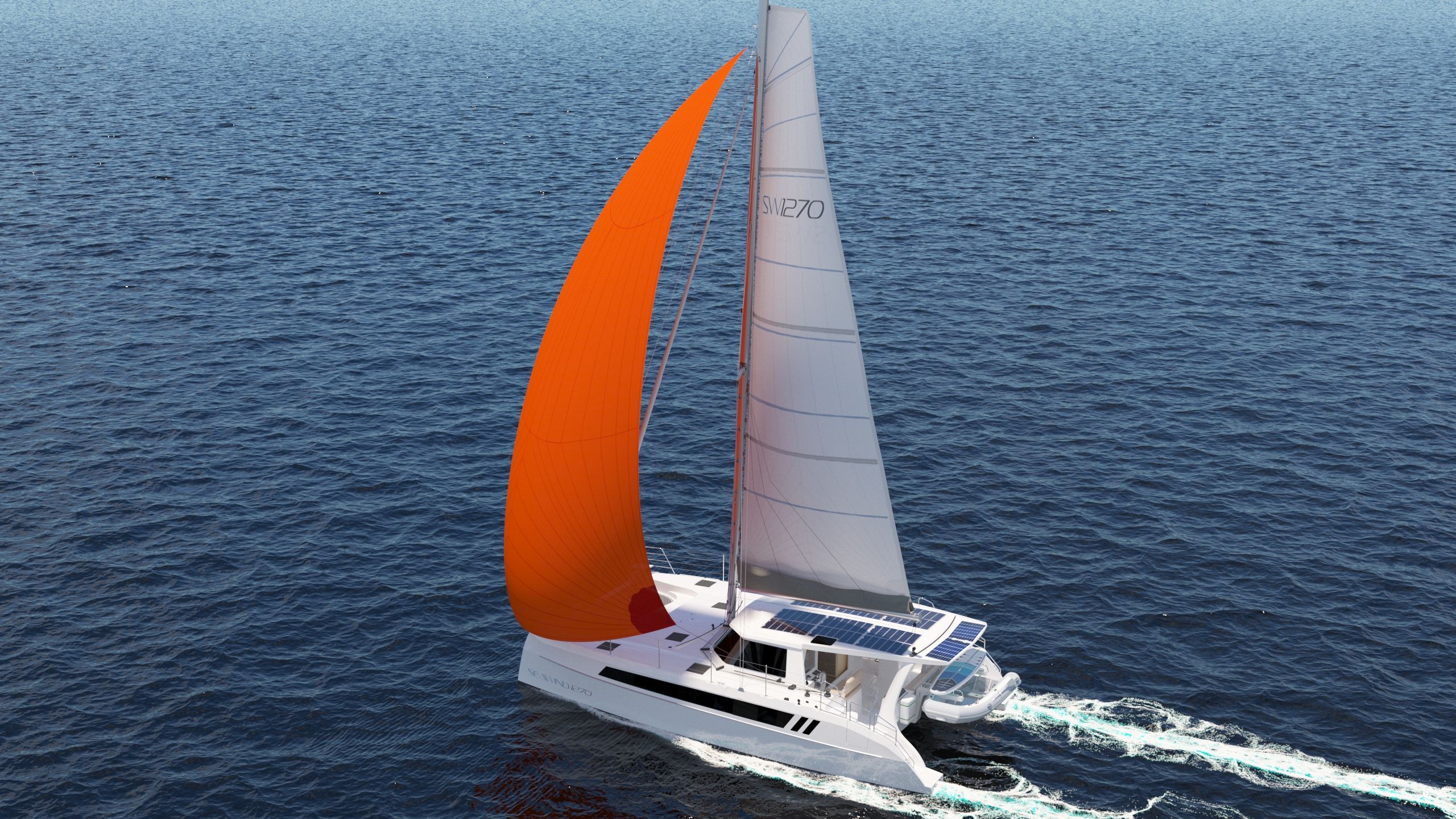
1270-Hero-banner — Seawind Catamarans
* A standard reference image, not the actual boat — shown to help visualise this model's published dimensions.
From the published figures: CE Category A · LOA 12.83 m · fresh water 600 L
From the published figures: LOA 12.83 m · upwind 103.8 m²
From the published figures: LOA 12.83 m · 4 cabins · fresh water 600 L
Tags are derived from certified class, length, sail area, accommodation and tankage using the criteria described on the Sources page; an editor may add or remove one.
Classic yacht-design ratios worked out from the builder's published figures, each shown against the bands designers read it by.
How much sail the boat carries for its weight — its power in light air.
sail area (ft²) ÷ (displacement as ft³ of seawater)^⅔
published upwind sail area
How heavy the boat is for its waterline length. Lower is lighter and quicker; higher is steadier and roomier.
displacement (long tons) ÷ (0.01 × waterline length in ft)³
Most builders publish a light displacement. The ratios were defined on a loaded boat, so every boat here reads a little lighter than a surveyor's figure would — all alike, which keeps them comparable.
What the builder publishes about how fast, how strong and how much the boat carries.
Fuel and water on one scale: a tank twice the height holds twice as much.
Certified CE design category A (Ocean): the wind and waves the EU Recreational Craft Directive says this boat is designed to take.
Sheltered waters
Inshore
Offshore
Ocean
Design limits set by the EU Recreational Craft Directive (2013/53/EU), in significant wave height. A category covers the conditions of those below it. It is the limit the boat was designed to, not a promise that it is safe in any conditions within it — that judgement stays with the skipper.
A figure marked with a quote mark was read from the builder's page. Open it for the exact line, the page and the date.
Figures read fromthe builder's page
Premium production
Australian builder of bluewater cruising catamarans, founded in Sydney in 1982, now manufacturing in Vietnam and Turkey.
Seawind was established in Sydney in 1982, building the four-to-five-metre off-the-beach Maricat, which became the most popular Australian-built catamaran with over 3,000 made. The 24-foot Seawind 24 of 1987 became a world benchmark for small cruising cats with over 350 built and exported from America to Japan; the 28-foot Seawind 850 of 1991 opened the way to larger cruising designs, and the 33-foot Seawind 1000 of 1994 was named Australian Sailboat of the Year, the first catamaran ever so honoured. The 1050 Resort and 1200 flagships came in 1998, the Venturer power cats in 2000, and the Seawind 1160 with its tri-fold door in 2004, winning the Australian industry's best non-trailerable sailboat award in 2005 and two categories of the US Boat of the Year in 2006. In 2010 Seawind acquired the trimaran builder Corsair Marine, moved key Australian staff to Vietnam in 2011 to set up production there, and by 2012 had relocated the 1000XL2, 1160 and 1250 to the Corsair factory; the 1160 Lite followed in 2014, and in 2015 the 52-foot 1600, the 1260, the 1190 Sport and the 1160 Resort were announced -- the 1190 Sport winning its first offshore regatta and Cruising World's Boat of the Year in 2016.
Visit brand pageEvery model Seawind Catamarans publishes, by length — where this one sits in the range.
Bali
LOA: 12.33 m
Lagoon
LOA: 13.12 m
Bali
LOA: 12.08 m