Sail area / displacement
How much sail the boat carries for its weight — its power in light air.
- 17.4· Cruiser
How it is worked out
sail area (ft²) ÷ (displacement as ft³ of seawater)^⅔
published upwind sail area
1 / 11
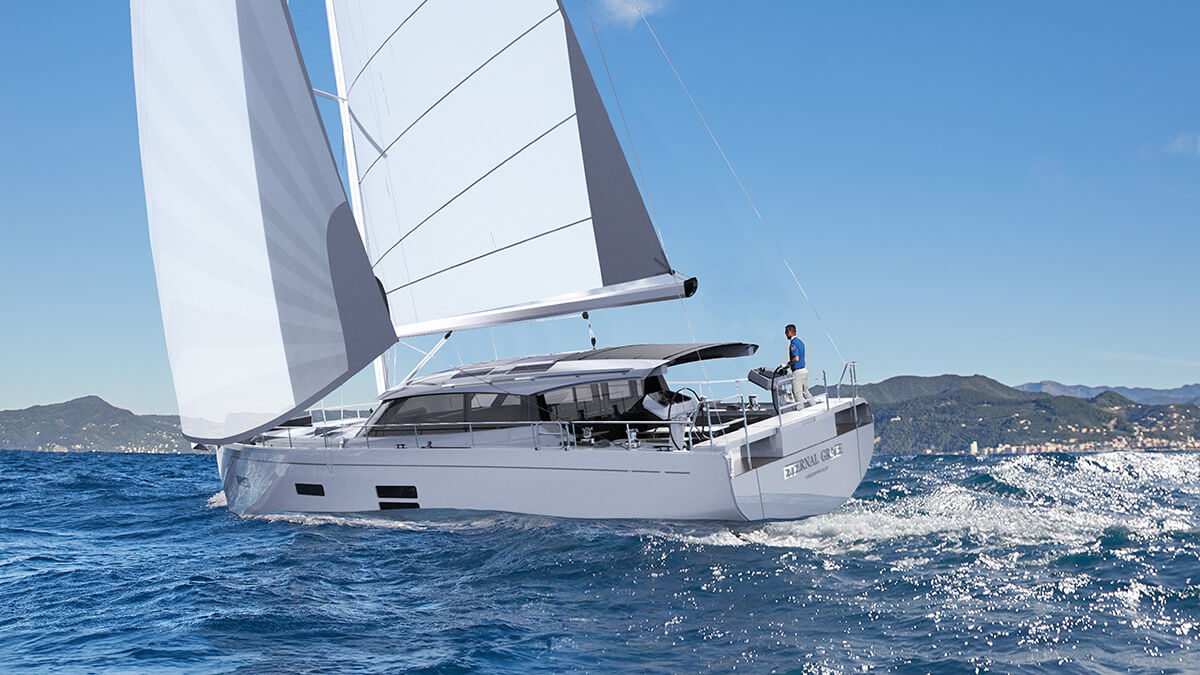
Moody Decksaloon 48 exterior — Moody
* A standard reference image, not the actual boat — shown to help visualise this model's published dimensions.
From the published figures: CE Category A · LOA 15.42 m · fresh water 766 L
From the published figures: LOA 15.42 m · 3 cabins · fresh water 766 L
Tags are derived from certified class, length, sail area, accommodation and tankage using the criteria described on the Sources page; an editor may add or remove one.
Classic yacht-design ratios worked out from the builder's published figures, each shown against the bands designers read it by.
How much sail the boat carries for its weight — its power in light air.
sail area (ft²) ÷ (displacement as ft³ of seawater)^⅔
published upwind sail area
How heavy the boat is for its waterline length. Lower is lighter and quicker; higher is steadier and roomier.
displacement (long tons) ÷ (0.01 × waterline length in ft)³
The share of the weight carried in the keel — a rough guide to stiffness, though how deep that weight sits matters as much.
ballast ÷ displacement × 100
Ted Brewer's measure of how gently a boat moves in a seaway. Higher means a slower, easier motion.
displacement (lb) ÷ (0.65 × (0.7 × LWL + 0.3 × LOA) × beam^1.333), lengths in ft
A guide from the inquiry after the 1979 Fastnet race: below 2 was taken as suited to ocean passages. It ignores hull shape and where the ballast sits.
beam (ft) ÷ (displacement as ft³ of seawater)^⅓
Roughly the speed a displacement hull reaches before it has to climb its own bow wave.
1.34 × √(waterline length in ft), in knots
Most builders publish a light displacement. The ratios were defined on a loaded boat, so every boat here reads a little lighter than a surveyor's figure would — all alike, which keeps them comparable.
What the builder publishes about how fast, how strong and how much the boat carries.
Fuel and water on one scale: a tank twice the height holds twice as much.
Certified CE design category A (Ocean): the wind and waves the EU Recreational Craft Directive says this boat is designed to take.
Sheltered waters
Inshore
Offshore
Ocean
Design limits set by the EU Recreational Craft Directive (2013/53/EU), in significant wave height. A category covers the conditions of those below it. It is the limit the boat was designed to, not a promise that it is safe in any conditions within it — that judgement stays with the skipper.
A figure marked with a quote mark was read from the builder's page. Open it for the exact line, the page and the date.
Figures read fromthe builder's page
Premium production
British builder of deck saloon sailing yachts, founded in Swanwick in 1827 and owned by Germany's HanseYachts AG since 2007.
The Moody yard traces back to the 19th century; in 1935 the founder's grandson Alexander Herbert Moody, trained in shipbuilding from his youth, turned the family business from repairs to building sailing yachts. Moody introduced its first deck-saloon yacht, the Carbineer 46, in 1969, built its last wooden deck saloon, the Frederick Parker-designed Swan Dancer, in 1970, and in 1972 launched the Moody 44, the first yacht to carry the founder's name, with teak decks, a generous centre cockpit and wheel steering. When the oil crisis of the 1970s hit, the brand formed a partnership in 1973 with Marine Projects (Plymouth) Ltd that, guided by designers such as Bill Dixon and Angus Primrose, produced 39 models from 27 to 64 feet and 4,233 boats over three decades. In 2005 the founding family entrusted the marque to Premier Marinas in Swanwick, production paused briefly, and in 2007 HanseYachts AG acquired the brand and began building Moody deck-saloon and aft-cockpit yachts again.
Visit brand pageEvery model Moody publishes, by length — where this one sits in the range.
Boats this boat's designers also drew, for other builders too. Credits are grouped only where the names clearly agree, however each builder spelled them; an unclear one is left out.
Hallberg-Rassy
LOA: 16.34 m
Bestevaer
LOA: 16.17 m
Hallberg-Rassy
Hallberg-Rassy