Sail area / displacement
How much sail the boat carries for its weight — its power in light air.
- 17.9· Cruiser
How it is worked out
sail area (ft²) ÷ (displacement as ft³ of seawater)^⅔
published upwind sail area
1 / 5
Bavaria Yachtbau GmbH
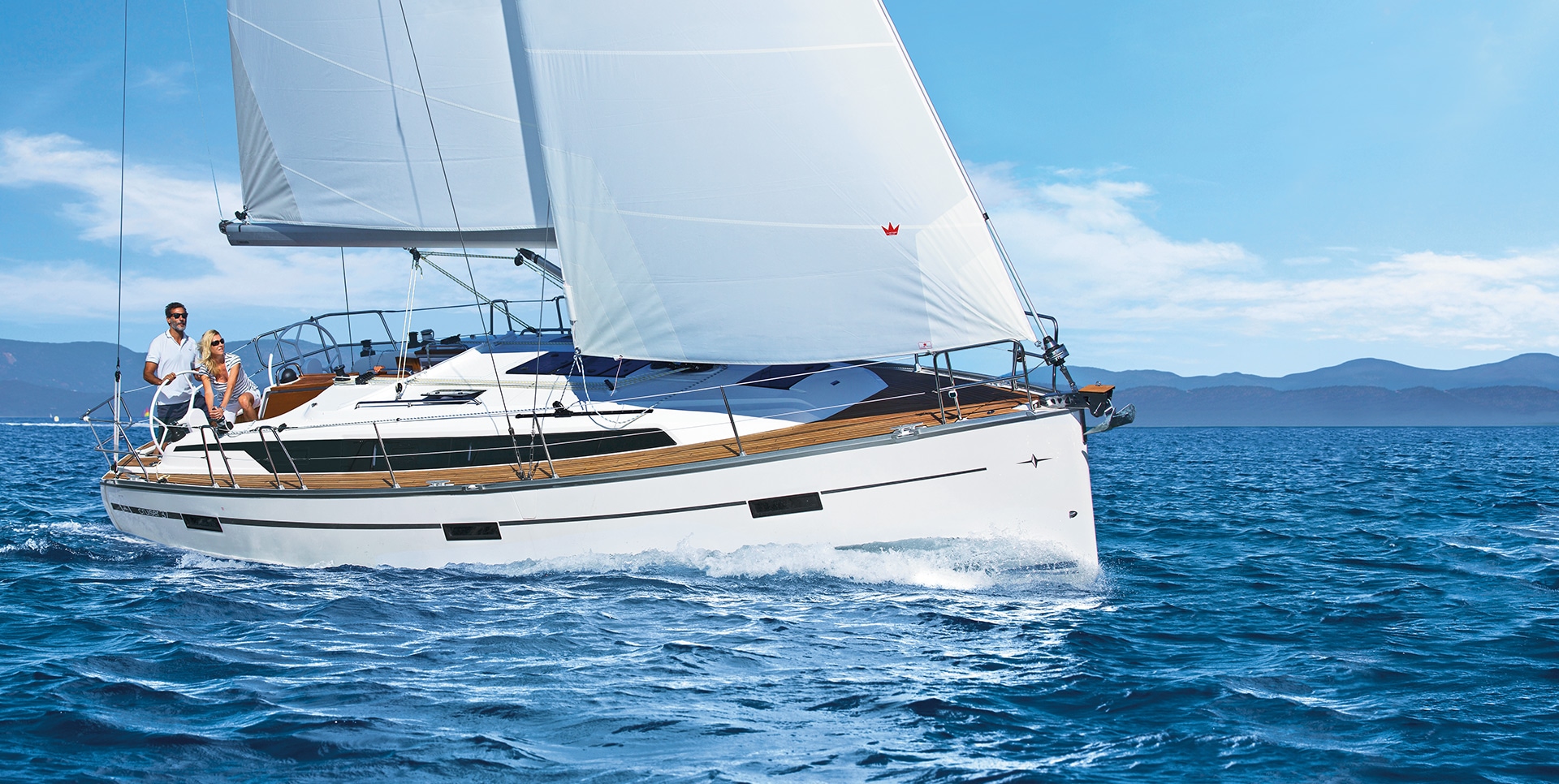
* A standard reference image, not the actual boat — shown to help visualise this model's published dimensions.
From the published figures: LOA 11.3 m · upwind 67 m²
Tags are derived from certified class, length, sail area, accommodation and tankage using the criteria described on the Sources page; an editor may add or remove one.
Classic yacht-design ratios worked out from the builder's published figures, each shown against the bands designers read it by.
How much sail the boat carries for its weight — its power in light air.
sail area (ft²) ÷ (displacement as ft³ of seawater)^⅔
published upwind sail area
How heavy the boat is for its waterline length. Lower is lighter and quicker; higher is steadier and roomier.
displacement (long tons) ÷ (0.01 × waterline length in ft)³
The share of the weight carried in the keel — a rough guide to stiffness, though how deep that weight sits matters as much.
ballast ÷ displacement × 100
Ted Brewer's measure of how gently a boat moves in a seaway. Higher means a slower, easier motion.
displacement (lb) ÷ (0.65 × (0.7 × LWL + 0.3 × LOA) × beam^1.333), lengths in ft
A guide from the inquiry after the 1979 Fastnet race: below 2 was taken as suited to ocean passages. It ignores hull shape and where the ballast sits.
beam (ft) ÷ (displacement as ft³ of seawater)^⅓
Roughly the speed a displacement hull reaches before it has to climb its own bow wave.
1.34 × √(waterline length in ft), in knots
Most builders publish a light displacement. The ratios were defined on a loaded boat, so every boat here reads a little lighter than a surveyor's figure would — all alike, which keeps them comparable.
What the builder publishes about how fast, how strong and how much the boat carries.
Fuel and water on one scale: a tank twice the height holds twice as much.
Figures read fromthe builder's page
Volume production
German builder of sailing yachts and motorboats, founded 1978 and based at its shipyard in Giebelstadt near Würzburg.
Until 1978 the site at Giebelstadt near Würzburg held a factory making PVC windows. Winfried Hermann, a sailor himself, saw in that factory and its workforce the makings of a yard, and founded it on a simple idea: build yachts industrially so they could be offered at prices that put a new boat within many more people's reach. The first motorboats followed in 2001 and succeeded as quickly as the sailing yachts had, on the same combination of quality and price. By 2010 the yard judged that buyers wanted more again -- not only speed and safety under sail but the fittings and finish of a modern holiday home -- and the yacht it builds today is a far more complex thing to make than one of 1978. Giebelstadt still builds every Bavaria from first laminate to final polish: 200,000 square metres holding four production lines of 125 metres each, two halls for hulls and decks, and a joinery where the whole interior is made, with about 700 people producing more than 600 sailing yachts and motorboats a year.
Visit brand pageEvery model Bavaria Yachts publishes, by length — where this one sits in the range.
Elan
LOA: 11.99 m
Bavaria Yachts
LOA: 11.31 m
Beneteau
LOA: 10.77 m
Rustler Yachts
LOA: 11.28 m