Power to weight
Total engine power per tonne of published displacement — more means livelier acceleration for the hull. Drawn for motor yachts.
115.4 hp/t
2 × 300 hp · 5.2 t
1 / 10
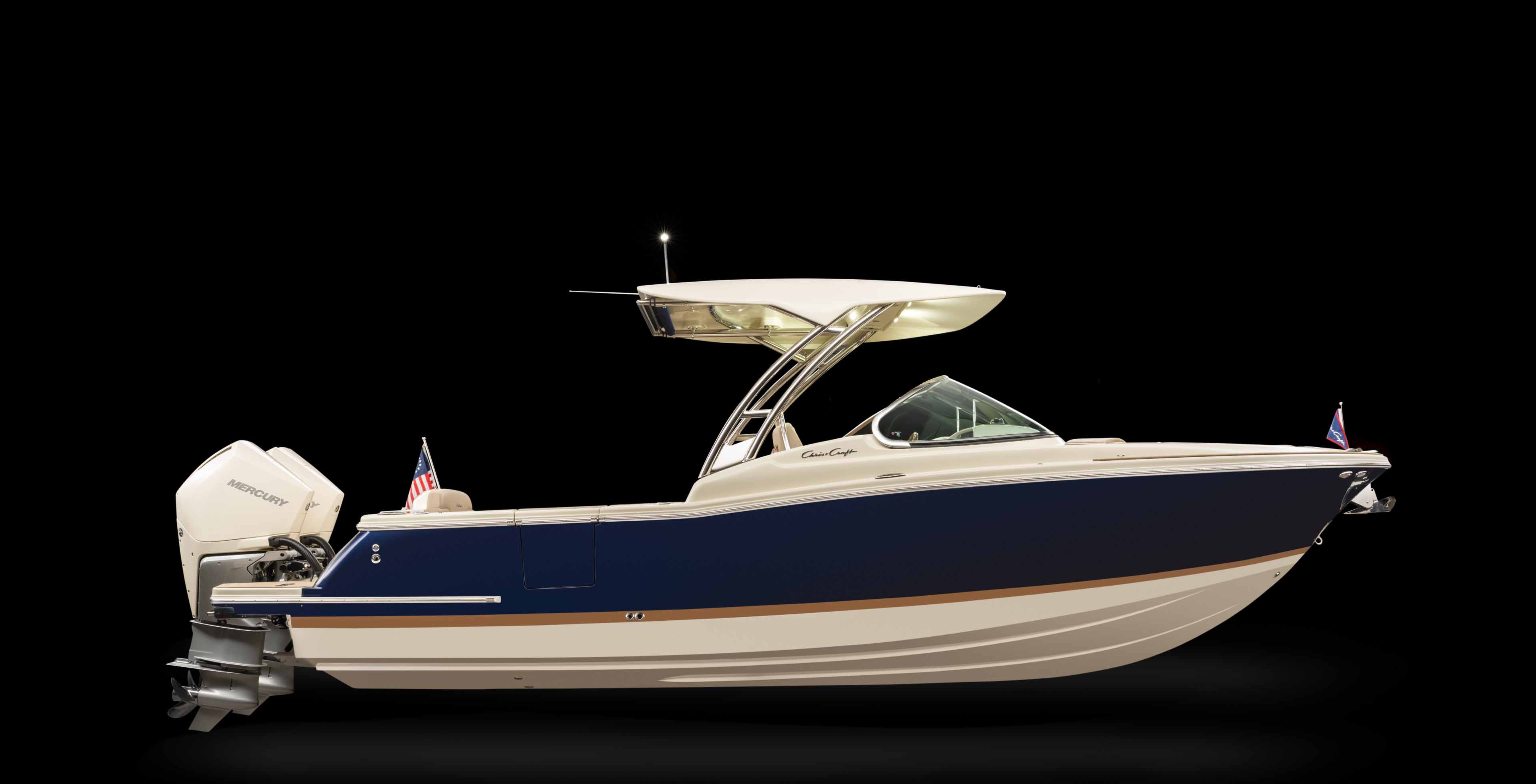
calypso-28-header-carousel-1 — Chris-Craft
* A standard reference image, not the actual boat — shown to help visualise this model's published dimensions.
From the published figures: day boat · LOA 9 m
Tags are derived from certified class, length, sail area, accommodation and tankage using the criteria described on the Sources page; an editor may add or remove one.
What the builder publishes about how fast, how strong and how much the boat carries.
Total engine power per tonne of published displacement — more means livelier acceleration for the hull. Drawn for motor yachts.
115.4 hp/t
2 × 300 hp · 5.2 t
Fuel and water on one scale: a tank twice the height holds twice as much.
Figures read fromchriscraft.com/models/calypso-series/calypso-28· Calypso 28 Specificationsread 10/17/2026
Premium production
American runabout builder whose history goes back to 1874, handcrafted in Sarasota, Florida, and owned by Winnebago Industries — twelve sterndrive and outboard models from 7.6 to 11.3 m in the Sportster, Launch, Launch GT, Corsair, Calypso and Catalina series.
Chris-Craft's story begins in the small town of Algonac, Michigan, where 13-year-old Christopher Columbus Smith built his first boat in 1874; his punts and skiffs soon made his name as a master boatbuilder, and as demand grew he joined forces with his brother Hank and began building full time, laying the groundwork for 'standardized' runabouts. The Smith Ryan Boat Company, formed in 1910, built fast, economical runabouts for the masses; after a change of name to the Chris Smith & Sons Boat Company, Chris's son Jay Smith became president and general manager in 1927, and during his 31 years Chris-Craft became known as the world's largest builder of mahogany powerboats. Sales dipped in the Great Depression and the company returned to runabouts, then during the Second World War built patrol boats, utility launches and rescue vessels for the US Navy and Army, delivering 12,000 by 1945. After the war the powerboat lineup reached 139 models, and the first fiberglass boat appeared in 1955. In 1971 the last mahogany boat was built, a 57-foot Constellation; through the 1980s and early 1990s Chris-Craft returned to sport boats, building high-performance racing catamarans and performance boats for its traditional customers. An investment group bought the company in 2001, which introduced three new Heritage models and a 43-foot Roamer yacht. Today the boats are built by long-serving craftsmen at the factory in Sarasota, Florida.
Visit brand pageEvery model Chris-Craft publishes, by length — where this one sits in the range.