Sail area / displacement
How much sail the boat carries for its weight — its power in light air.
- not published: sail area, displacement
How it is worked out
sail area (ft²) ÷ (displacement as ft³ of seawater)^⅔
1 / 10
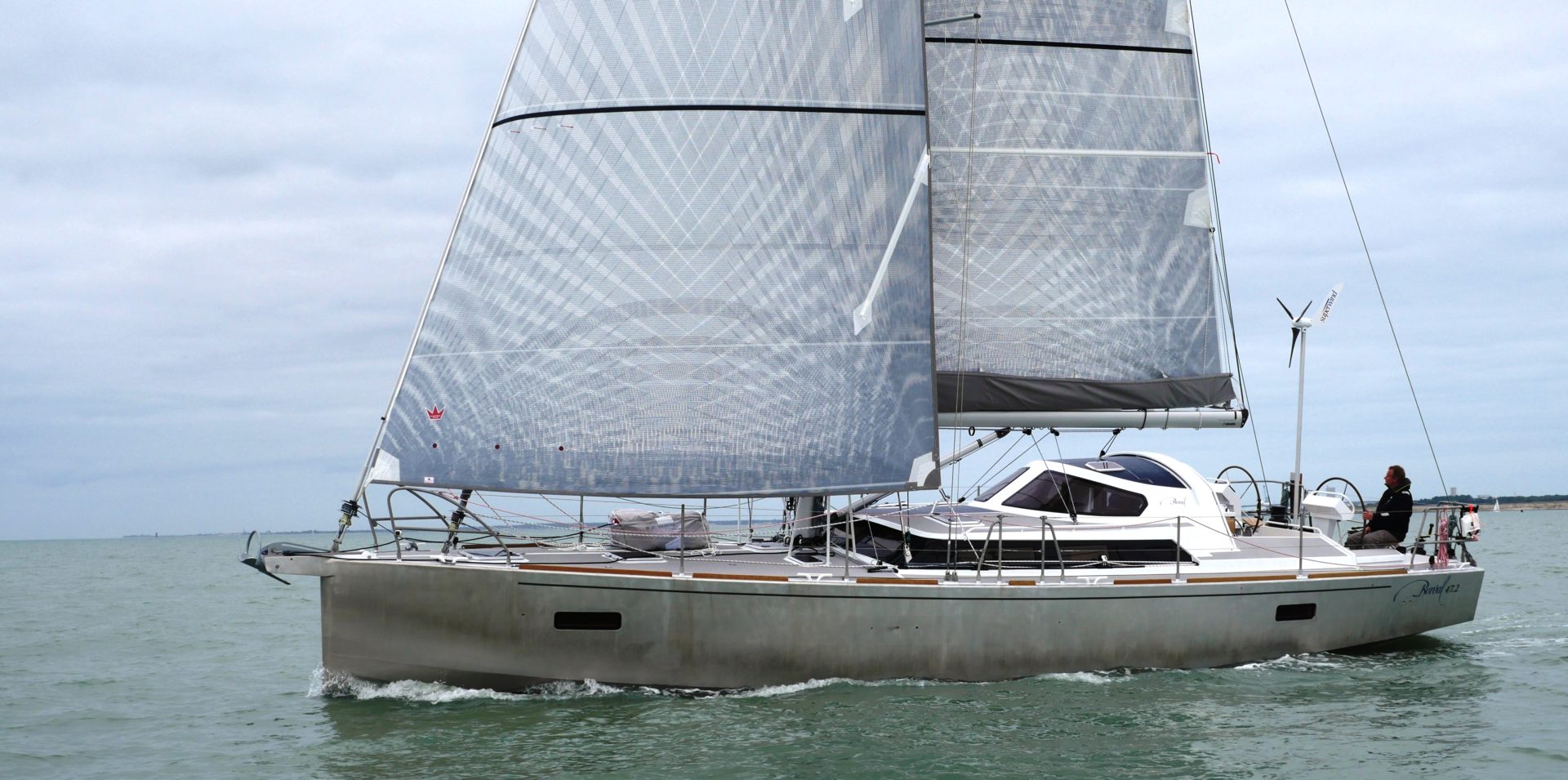
2-1920x955 — Boréal Yachts
* A standard reference image, not the actual boat — shown to help visualise this model's published dimensions.
Classic yacht-design ratios worked out from the builder's published figures, each shown against the bands designers read it by.
How much sail the boat carries for its weight — its power in light air.
sail area (ft²) ÷ (displacement as ft³ of seawater)^⅔
How heavy the boat is for its waterline length. Lower is lighter and quicker; higher is steadier and roomier.
displacement (long tons) ÷ (0.01 × waterline length in ft)³
The share of the weight carried in the keel — a rough guide to stiffness, though how deep that weight sits matters as much.
ballast ÷ displacement × 100
Ted Brewer's measure of how gently a boat moves in a seaway. Higher means a slower, easier motion.
displacement (lb) ÷ (0.65 × (0.7 × LWL + 0.3 × LOA) × beam^1.333), lengths in ft
A guide from the inquiry after the 1979 Fastnet race: below 2 was taken as suited to ocean passages. It ignores hull shape and where the ballast sits.
beam (ft) ÷ (displacement as ft³ of seawater)^⅓
Roughly the speed a displacement hull reaches before it has to climb its own bow wave.
1.34 × √(waterline length in ft), in knots
Most builders publish a light displacement. The ratios were defined on a loaded boat, so every boat here reads a little lighter than a surveyor's figure would — all alike, which keeps them comparable.
What the builder publishes about how fast, how strong and how much the boat carries.
Fuel and water on one scale: a tank twice the height holds twice as much.
Figures read fromboreal-yachts.com/portfolio/le-boreal-47-2/· Characteristicsread 10/18/2026hull material from /boreal-concept-2/
Semi-custom
Breton builder of aluminium centreboard expedition sailboats founded in 2005 by navigator-designer Jean-François Delvoye — four models from the 13.9-metre Boréal 44.2 to the 21.6-metre Boréal 70, built at Minihy-Tréguier for the tropics and the high latitudes alike.
The first Boréal was born from the notebooks and sketchbooks Jean-François Delvoye kept on a six-year family voyage round the world with his wife and four children, aboard a 12-metre yacht he had built himself in his garden: from the Mediterranean to Cape Verde, Brazil and Argentina, ending with two years in the channels of Patagonia, asking every sailor they met what their boat lacked to be the best in the world. Back in France he drew the 15-metre aluminium Boréal 50 in every detail in 3D, meaning to build it and sail again; instead two yachts were sold before the prototype touched the water, and the company Boréal was created in 2005, a little by chance, with three experienced clients. In 2010 he joined forces with Jean-François Eeman, met on a pontoon in Ushuaia, for whose family the first Boréal 44 was built; when Eeman set off round the world again in 2020 on his Boréal 47, Eric Vautrin took the helm alongside Delvoye, who designs every boat and heads the design office while Vautrin looks after the clients. The Boréal 44, launched in 2009, was Yacht of the Year 2010 in France and in 2011 in the Netherlands; the Boréal 52 was European Yacht of the Year 2015 among bluewater cruisers; the Boréal 47, shown at Annapolis in 2017, was named Best Midsize Cruiser and overall Boat of the Year 2018; and the Boréal 47.2 won Voile Magazine's jury prize and European Yacht of the Year 2021 in the bluewater class.
Visit brand pageEvery model Boréal Yachts publishes, by length — where this one sits in the range.