Sail area / displacement
How much sail the boat carries for its weight — its power in light air.
- not published: sail area
How it is worked out
sail area (ft²) ÷ (displacement as ft³ of seawater)^⅔
1 / 10
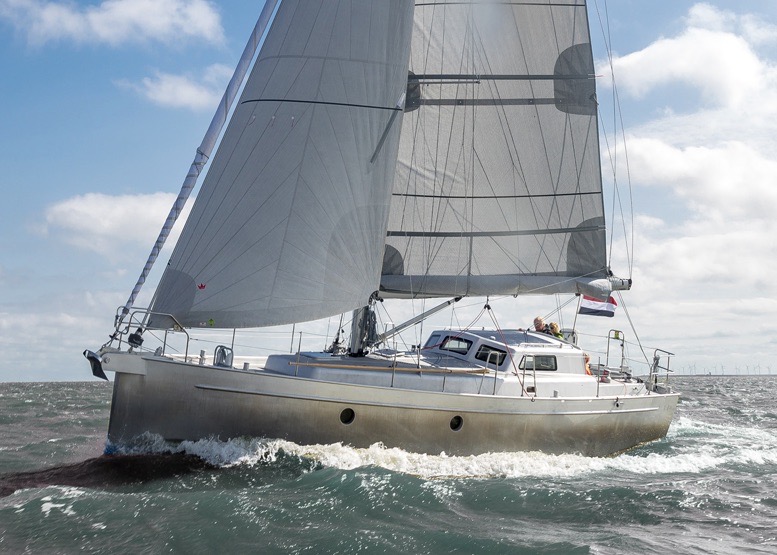
Bestevaer 36 exterior at anchor — Bestevaer
* A standard reference image, not the actual boat — shown to help visualise this model's published dimensions.
Classic yacht-design ratios worked out from the builder's published figures, each shown against the bands designers read it by.
How much sail the boat carries for its weight — its power in light air.
sail area (ft²) ÷ (displacement as ft³ of seawater)^⅔
How heavy the boat is for its waterline length. Lower is lighter and quicker; higher is steadier and roomier.
displacement (long tons) ÷ (0.01 × waterline length in ft)³
The share of the weight carried in the keel — a rough guide to stiffness, though how deep that weight sits matters as much.
ballast ÷ displacement × 100
Ted Brewer's measure of how gently a boat moves in a seaway. Higher means a slower, easier motion.
displacement (lb) ÷ (0.65 × (0.7 × LWL + 0.3 × LOA) × beam^1.333), lengths in ft
A guide from the inquiry after the 1979 Fastnet race: below 2 was taken as suited to ocean passages. It ignores hull shape and where the ballast sits.
beam (ft) ÷ (displacement as ft³ of seawater)^⅓
Roughly the speed a displacement hull reaches before it has to climb its own bow wave.
1.34 × √(waterline length in ft), in knots
Most builders publish a light displacement. The ratios were defined on a loaded boat, so every boat here reads a little lighter than a surveyor's figure would — all alike, which keeps them comparable.
What the builder publishes about how fast, how strong and how much the boat carries.
Fuel and water on one scale: a tank twice the height holds twice as much.
Certified CE design category A (Ocean): the wind and waves the EU Recreational Craft Directive says this boat is designed to take.
Sheltered waters
Inshore
Offshore
Ocean
Design limits set by the EU Recreational Craft Directive (2013/53/EU), in significant wave height. A category covers the conditions of those below it. It is the limit the boat was designed to, not a promise that it is safe in any conditions within it — that judgement stays with the skipper.
A figure marked with a quote mark was read from the builder's page. Open it for the exact line, the page and the date.
Figures read fromthe builder's page
Semi-custom
Dutch builder of go-anywhere aluminium explorer sailing and motor yachts, designed by Gerard Dijkstra since 2003 and built by KM Yachtbuilders in Makkum.
The line began with a naval architect building for himself: Gerard Dijkstra, a polar sailor as well as a designer, drew the Bestevaer II as his own ideal boat -- unrestricted short-handed sailing, safe, comfortable and good-looking -- and brought to it what he had learned racing, designing and sailing in ice. What followed became a family of go-anywhere aluminium yachts built by KM Yachtbuilders. Tranquilo, a 56-footer meant for singlehanding, has sailed the Northwest Passage alone twice, in 2012 and 2017, explored Patagonia and the Antarctic peninsula and wintered ten months in the frozen seas of northern Canada. The first 49-footer, Katharos, came in 2009; Morning Haze, a 55-footer with a lifting keel, left on a world voyage straight from delivery, has been to Greenland three times and crossed the Northwest Passage in 2018; and the 66-foot Anabel was the first able to reach the far corners of the world entirely self-reliantly, on batteries, deck solar and two telescopic wind generators. The semi-custom Pure series, derived from the Bestevaer II and offered at 45, 49 and 53 feet, arrived in 2016, and the 45 was nominated Sailing Yacht of the Year. A 53-foot explorer motor yacht followed in 2020, drawn on the same principles; the 72-foot Symbiose is the largest one-off; and the Bestevaer 36, the smallest and greenest, shallow enough to dry out in the Wadden Sea, won a European Yacht of the Year 2024 special mention for sustainability.
Visit brand pageEvery model Bestevaer publishes, by length — where this one sits in the range.